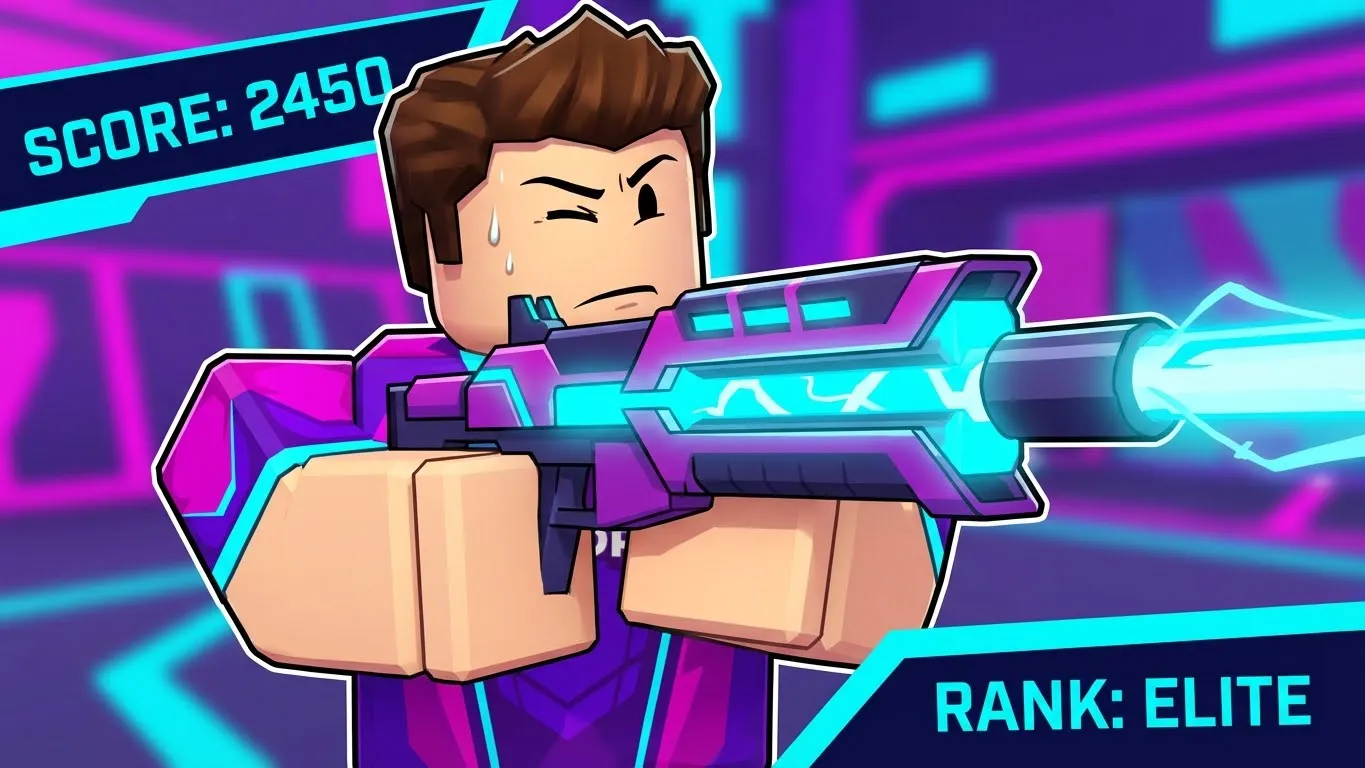
Rivals hit Roblox in 2025 and changed what competitive FPS games on the platform could be.
Unlike older Roblox shooters with janky movement and questionable hit detection, Rivals feels polished. The gunplay is responsive. The movement is smooth. And if you’re getting destroyed in matches, it’s usually because you’re being outplayed - not because the game is broken.
Which means: you can actually improve at this game. And improvement feels good.
In this guide, we’re covering everything you need to go from complete beginner to ranked-ready - mechanics, aiming fundamentals, weapon choices, common mistakes, and the settings tweaks that actually matter.
Rivals rewards skill, not just time invested. If you put in focused practice on the right things, you’ll see improvement within days - not weeks.
Why Rivals Is Worth Learning
Before we dive into how to improve, let’s talk about why Rivals is different.
Most Roblox FPS games feel like compromises. You play them because they’re on Roblox, not because they compete with actual competitive shooters. Rivals breaks that pattern.
What makes it special:
- Smooth movement mechanics that reward practice
- Consistent hit registration you can actually trust
- Skill-based matchmaking that (mostly) works
- Active development with regular balance patches
- Growing competitive scene with tournaments
As we covered in our 2025 year-in-review, Rivals proved Roblox could host legitimate competitive FPS experiences. Now you just need to learn how to play it.
Understanding the Core Mechanics
Movement Fundamentals
Movement in Rivals isn’t complicated, but small optimizations make massive differences.
Basic movement:
- WASD to move (obviously)
- Space to jump
- Shift to sprint (most weapons)
- Crouch for accuracy (situational)
What separates good movement from great:
Strafing matters. Standing still is death. Always be moving side-to-side, even while aiming. Good players hit shots while strafing. Great players make themselves harder to hit while doing it.
Jump shooting works, but not always. Some weapons maintain accuracy while jumping (SMGs, some pistols). Others become useless mid-air (snipers, rifles). Learn which weapons you can jump-shoot with.
Sprint management. Sprinting is loud and prevents shooting. Use it to rotate between cover or close distance, but never sprint into sight lines. Good players hear you coming.
Peeking corners. Don’t walk straight around corners. Peek by strafing out just far enough to see, then strafe back into cover. This minimizes exposure time.
Aiming Basics
Rivals has actual aim mechanics, which means practice matters.
Sensitivity settings:
- Lower sensitivity = easier to track targets
- Higher sensitivity = faster flicks and turns
- Most good players use lower than you’d expect
Start with lower sensitivity (0.3-0.5) and increase slowly if it feels too slow. It’s easier to aim precisely with lower sens, and you can always turn it up later.
Crosshair placement: Keep your crosshair at head level, aimed where enemies will appear. Good crosshair placement means you’re already aimed at targets before they appear.
Tracking vs. flicking:
- Tracking: Following moving targets with your crosshair
- Flicking: Snapping to targets quickly
Different weapons favor different styles. SMGs and rifles reward tracking. Snipers and shotguns reward flicks. Practice both.
Don’t overshoot. Common beginner mistake: moving crosshair past the target, then correcting back and forth. Slow down. Precision beats speed.
Weapon Recommendations for Beginners
Rivals has multiple weapon classes. Some are more beginner-friendly than others.
Best Starting Weapons
Assault Rifles (Medium range, balanced)
The most forgiving weapon class. Decent damage, manageable recoil, works at most ranges.
- Easy to control spray patterns
- Forgiving of aim mistakes
- Effective in most situations
- Good for learning fundamentals
Start here. Master rifles before moving to specialist weapons.
SMGs (Close range, high mobility)
Fast fire rate, good movement speed, dominant up close.
- Excel in close-quarters combat
- Require good tracking aim
- Lose at long range
- High risk, high reward
Good second weapon to learn. Forces you to master movement and positioning.
Weapons to Avoid Early
Snipers:
- Require perfect accuracy
- One mistake = you’re dead
- High skill floor
- Frustrating for beginners
Wait until your aim is consistent before maining snipers.
Shotguns:
- Very unforgiving
- Punish positioning mistakes
- Require perfect flicks
- High risk gameplay
Learn positioning first, then try shotguns.
Common Beginner Mistakes
Most new players make the same mistakes. Fixing these will instantly improve your gameplay.
Standing still while shooting. You’re an easy target. Even if it means missing a few shots, keep strafing. A living player who deals 80% damage beats a dead player who dealt 100%. Good players hit shots while moving. Great players make themselves nearly impossible to hit while doing it.
Reloading at bad times. Reloading in the open or mid-fight gets you killed. Reload behind cover. Don’t reload after every kill unless you’re safe. Count your shots and know when you’re low. If caught reloading mid-fight, switch weapons instead of finishing the reload animation.
Fighting at wrong ranges. Every weapon has optimal range. Fighting outside it means you lose to equally-skilled players with better weapon choice. If you have an SMG, get close or disengage - don’t try to outshoot rifles at medium range. If you have a rifle, keep distance from SMGs and don’t let them close the gap.
Ignoring sound. Rivals has directional audio that gives away enemy positions. Footsteps tell you where enemies are. Sprinting is loud - listen for it. Reloads and ability sounds give away enemy status. Wear headphones. Speakers put you at a massive disadvantage.
Solo pushing every fight. Even in deathmatch modes, smart players stick near teammates. 2v1 fights are nearly impossible to win. 1v1 fights are 50/50. 2v2 fights favor the better players. Don’t lone-wolf unless your aim is significantly better than your lobby.
Not using cover properly. Cover isn’t just for hiding - it’s for controlling engagements. Peek out to shoot, return to cover to reload. Force enemies to push into disadvantageous angles. Reset fights that aren’t going your way. But don’t sit still behind cover (you’re predictable), don’t peek the same angle repeatedly (enemies pre-aim it), and don’t stay in cover with 1 HP when you should be repositioning.
How to Actually Improve
Knowing what to do isn’t the same as doing it. Here’s how to turn knowledge into skill.
Warm up before ranked. Don’t jump straight into competitive cold. Spend 5-10 minutes in deathmatch mode focusing on hitting shots, not winning. Loosen up your movement and dial in your sensitivity. Cold aim is real - warm up fixes it.
Focus on one thing per session. Trying to improve everything at once improves nothing. Pick one skill and obsess over it for an entire session. “This session, I’m only working on crosshair placement.” “Today I’m practicing tracking moving targets.” “This game, I’m focusing on reload discipline.” Pick one skill. Master it. Move to the next.
Record your gameplay. You can’t fix mistakes you don’t notice. Record a few matches and watch them back. You’ll spot obvious mistakes immediately - times you stood still, bad peeks, fighting at wrong ranges, poor positioning. What feels fine in the moment looks terrible in replay. Record, watch, learn.
Play deathmatch for fundamentals. Ranked teaches you strategy. Deathmatch teaches you to shoot. Benefits: more fights per minute, less pressure for experimentation, instant respawns for more practice, faster learning of weapon matchups. Spend time in deathmatch until your aim feels consistent before grinding ranked.
Learn from better players. When you get destroyed, don’t tilt - learn. Watch how they peek corners, their crosshair placement, when they push versus play defensive, how they use abilities. Death cams are learning tools. Use them. Every death is a lesson if you’re paying attention.
Settings Optimization
Graphics Settings
Performance > visuals in competitive games.
- Lower graphics settings for higher FPS
- Disable motion blur and visual effects
- Minimize shadows and particles
- Target 60+ FPS minimum
If you’re on a low-end device, sacrifice every visual setting for smooth framerates.
Sensitivity
Already covered, but worth repeating:
Start around 0.3-0.5 sensitivity. Adjust in small increments (0.05) after multiple matches. Don’t change sensitivity every game.
Audio
- Enable game audio
- Use headphones
- Balance game sounds so footsteps are audible
- Lower music if it distracts you
Sound is information. Use it.
Climbing the Ranks
Once your fundamentals are solid, ranked rewards consistency and smart play.
What matters in ranked:
Win your 1v1s. If you’re losing most pure aim duels, your fundamentals need work. Don’t blame teammates until your K/D is positive.
Die less, not kill more. A 10-5 K/D is better than 15-12. Deaths hurt your team. Every death is a lost fight.
Play for round wins, not highlight clips. That risky sniper shot might look cool, but dying and losing the round doesn’t. Play percentage.
Adapt to opponents. If an enemy keeps beating you at close range, stop pushing them close. If you’re winning at medium range, force fights there.
Communicate (if possible). Callouts help. “Enemy low”, “Watching left”, “Pushing mid” - all useful. But don’t rage at teammates.
When Rivals Feels Impossible
Some days, you can’t hit anything. Normal.
What to do when you’re slumping:
Take a break. Tilt makes you worse. If you lose 3+ matches in a row, stop for an hour.
Drop to casual. Deathmatch with zero pressure often fixes aim slumps.
Check your setup. Is your mouse working? FPS stable? Sensitivity unchanged?
Sleep more. Seriously. Tired players have worse aim, worse reactions, worse decisions.
Remember it’s a game. If Rivals stops being fun, play something else. Burnout helps nobody.
Resources for Going Further
Practice in Training Mode: Rivals has target practice modes. Use them. Boring? Yes. Effective? Also yes.
Watch Tournament Players: See how the best players position, peek, and play. You’ll spot patterns you can copy.
Join the Community: Discord servers for Rivals have tips, strategies, and players to queue with. Learning with others is faster than solo grinding.
Improvement in Rivals isn’t about playing more - it’s about practicing deliberately. 30 minutes of focused practice beats 3 hours of autopilot grinding.
Final Thoughts
Rivals is the rare Roblox FPS that rewards putting in the work to improve.
If you focus on fundamentals - movement, aim, positioning, and smart decisions - you’ll see results. Most players in your lobbies aren’t trying to improve systematically. You will. That’s your edge.
Start with assault rifles. Practice in deathmatch. Focus on one skill at a time. Record and review your gameplay. And most importantly: stay patient. Improvement happens faster than you expect, but slower than you want.
See you in ranked.